
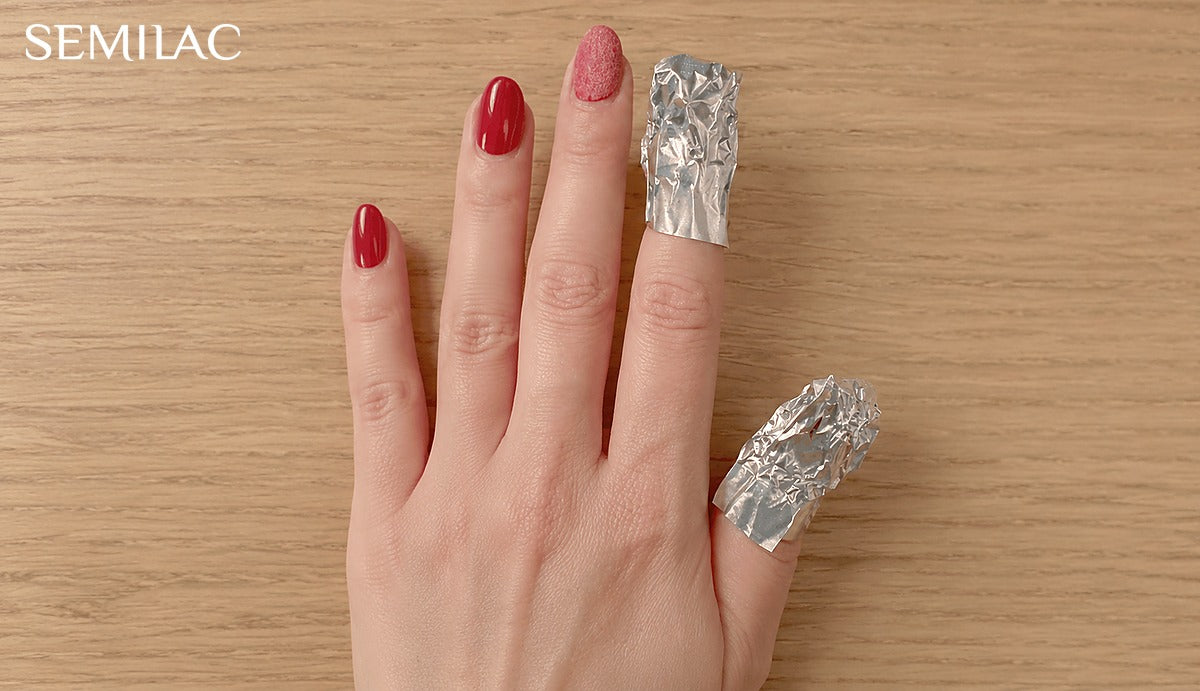
A safe soak-off has three rules: buff the top layer, give the remover its full time, and never force the gel. The wraps stay on for about 10 to 15 minutes. Gel that has softened comes away with light pressure from a pusher or a wooden stick. This guide gives you a fixed removal routine for the salon, so every new set starts on a healthy nail plate.
In this guide
Remover, kit, steps, mistakes, aftercare
How to choose between remover and acetone, the tools to keep at your desk, a nine-step soak-off routine, how to fit removal into the slot, the mistakes that damage the plate and what to do after the gel is off.
Why removal decides the quality of the next set
Clients judge you on the new set. But the new set depends on the removal before it. A plate that is thinned by heavy filing or scratched by forced scraping gives the base less to hold. The client then sees lifting and blames the product or your work.
A fixed routine protects you from that. You do the same steps in the same order for every client, so you do not skip one on a busy day. It also makes your timing predictable, which matters for the diary.
Remover or acetone: which liquid to use
This routine uses one of two Semilac liquids. You use both in the same way: with remover wraps, for about 10 to 15 minutes.
- Remover 500 ml is a liquid made to remove gel polish gently. It contains lanolin, which helps to moisturise and protect the nails and the skin around them. Choose it for clients with dry skin or dry cuticles. It also comes as Remover 1000 ml.
- Acetone 500 ml is a cosmetic acetone for removing gel polish. It also comes as Acetone 1000 ml for a busy salon.
One point for new techs: acetone does not wipe gel polish off in the way nail varnish remover wipes off classic varnish. The gel must soak under a wrap first. That is why the steps below matter.


The removal kit to keep at your desk
Removal needs few tools, but each one has a job. Keep them together in one tray, so you do not search for a file while the client waits.
- Remover Wraps 50 pieces: each foil has a dust-free pad. You soak the pad, put it on the nail and close the foil around the finger.
- Straight 180/240 Nail File: the fine file for the first step. The 180 and 240 sides are the gradation that the remover instructions name for buffing the top layer.
- Sanding Block: a four-sided block with a 180 gradation. Use it in place of the file if you prefer a block.
- Pusher 14,2 cm: surgical steel, made for pushing back cuticles and removing gel polish. It is easy to clean. Clean and disinfect it between clients.
- Wooden Sticks 10 pcs: camphor wood, rounded on one side and pointed on the other. Wood is softer than steel, so some techs prefer them on thin plates. Wood is porous, so use a new stick for each client.


The soak-off routine, step by step
Follow these nine steps in this order. The times come from the Semilac remover and acetone instructions.
- Look at the nails first. Check for lifting, cracks and any damage to the plate or the skin. Tell the client what you see before you start.
- Buff the top layer. Use a buffer or a 180/240 file and work gently. You only break the surface of the top coat, so the liquid can get in. Do not file down to the natural nail.
- Soak the pad. Wet the pad in each remover wrap with Remover or Acetone.
- Wrap each nail. Put the pad on the nail and close the foil firmly around the finger.
- Wait about 10 to 15 minutes. Leave the wraps closed for the full time.
- Open one wrap at a time. Take one foil off and work on that nail. The other nails stay wrapped until you reach them.
- Ease the gel away. Use a pusher or a wooden stick with light pressure. Softened gel comes away from the plate without force.
- Re-wrap if you feel resistance. If the gel does not move, close the wrap again and wait longer. Do not scrape.
- Finish the surface. Smooth the plate lightly with the sanding block, then wipe each nail with a dust-free pad and cleaner before the new set.
For the last step, Cleaner 500 ml degreases the natural plate and removes dust from the preparation. Use it with Cotton Pads Dust Free, which have 13 layers and leave no dust or fibres.
Pro tip
Wrap the first hand, then wrap the second hand. When you finish the second hand, the first hand has already had several minutes. You then work in the same order, and each nail gets a similar soak time.


Fit removal into the appointment
Removal has one fixed block of time: the 10 to 15 minutes under the wraps. You cannot shorten it safely. So plan for it when the client books, not when the client sits down.
- Ask at booking. "Do you have gel on now?" If the answer is yes, book the longer slot.
- List it on your menu. A "gel manicure with removal" service tells the client that removal takes time and has a value.
- Use the soak time. While the wraps are on, agree the colour and the shape, and prepare your base and top.
- Count your consumables. One full removal uses ten wraps. A pack of 50 covers five clients.
Before a busy season, our salon prep checklist for nail techs shows how to count stock against the sets in your diary.
Five mistakes that damage the nail plate
- Skipping the buff. An unbroken top coat keeps the liquid out. The gel then stays hard after the full time, and the tech starts to scrape.
- Opening the wraps early. The instructions say about 10 to 15 minutes. A shorter soak leaves gel that you must force off.
- Scraping with pressure. A steel pusher is a precise tool, not a chisel. If you need force, the gel needs more time.
- Using a coarse file on the plate. The 100 side of a Boat 100/180 file shortens nails and removes gel and acrylic mass. Do not use it on the surface of the natural plate. For the top layer, stay with 180/240.
- Letting the client peel. Peeling takes layers of the plate with the gel. Say it at every appointment: never peel, book a removal.
Do you remove builder products or work with an e-file? Check each product page to see how that product is removed. For safe e-file work, read our nail drill guide for nail techs.
After removal: a new set or a break
Most clients want a new set at once. After the cleaner wipe, the plate is ready for your normal preparation and for the base. Base Coat is the basic base for the natural nail plate.
Some clients want a break from gel, and some plates need one. Offer these clients a conditioner and an oil to use at home.
- Rescue Care Nail Conditioner: a vegan, strengthening conditioner for weakened nails. It contains calcium, soy and wheat proteins and diamond dust.
- Protect & Care Nail Conditioner: a vegan conditioner for weak and brittle nails. It contains wheat germ oil, tea tree oil and rosemary leaf extract.
- Cuticle Oil Coconut: an oil for nails and cuticles. The client applies it to the nail and the skin around it, then massages it in.
Clients who remove gel at home between visits need the same rules. Send them our guide on how to remove gel nails at home without damage, so they follow the steps you use in the salon.


PRO account
Approved PRO customers get a permanent 20% discount on full-priced products. UK delivery is free on orders over £25, so you can restock remover, wraps and files in one order.
Gel removal: questions from techs
How long does it take to soak off gel polish?
The wraps stay on for about 10 to 15 minutes. Add time to buff the top layer first and to ease the gel away afterwards.
Is remover or acetone better for gel polish removal?
You use both in the same way. Semilac Remover contains lanolin, which helps to moisturise and protect the nails and the skin around them. Choose it for clients with dry skin.
Why does the gel stay hard after 15 minutes?
Check two things. The top layer must be buffed, and the wrap must close firmly around the finger. Then re-wrap the nail and wait longer.
Which file do I use before a soak-off?
A buffer or a file with a 180/240 gradation. You only buff the top layer.
Should I use a pusher or a wooden stick?
Both work on softened gel. The steel pusher is easy to clean. Disinfect it between clients. A wooden stick is single-use. Wood is softer than steel, so some techs prefer the stick on thin plates.


