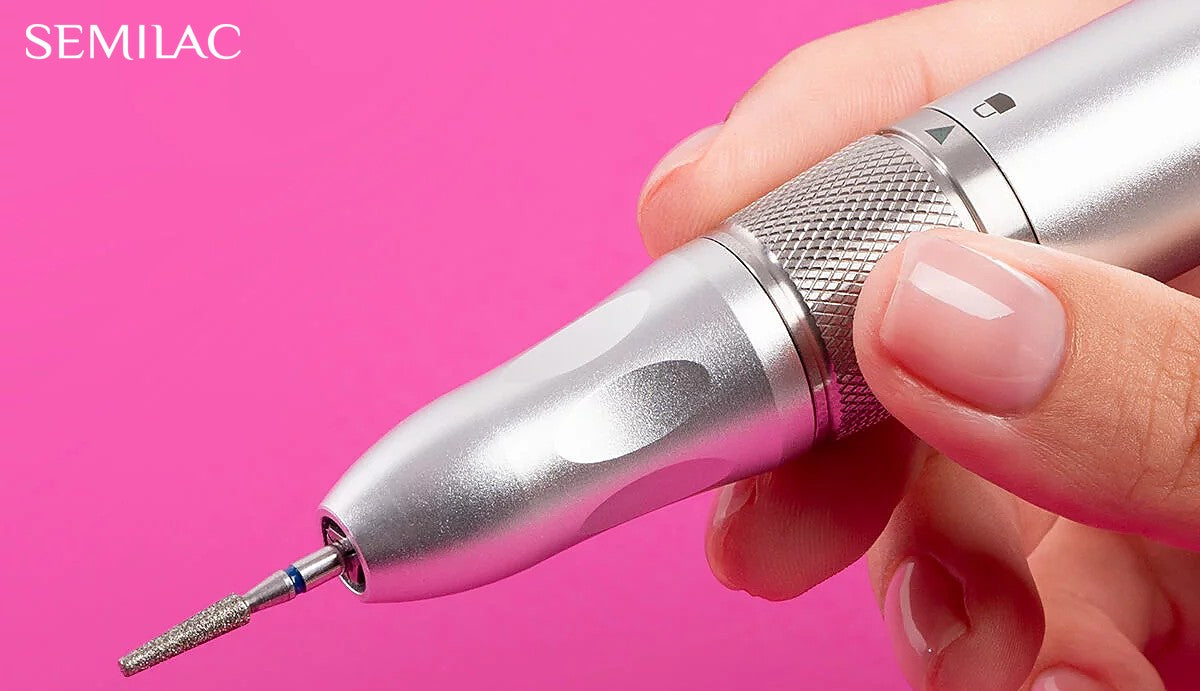
A nail drill is only as safe as the bit, the speed and the hand behind it. Use carbide to remove product and fine or medium diamond near the skin. Start cuticle work around 5,000 to 12,000 RPM and product removal higher, keep the bit moving with light pressure, and file over extraction.
Before you pick up the handpiece
Check every client's nails and skin before you switch the drill on. Recognise, adapt and refer, but never diagnose.
Stop the service
Fungal, viral, bacterial or parasitic infections, and severe skin conditions.
Restrict or adapt
Psoriasis, dermatitis, severe nail separation, broken bones, unexplained redness or swelling, and damaged or thinning nails.
If a client has sudden, unexplained nail separation or discolouration, pause the service and suggest they see their GP.
Carbide, diamond and ceramic: what each bit is for
Carbide
Machined flutes that shave product away. For removing gel polish, builder gel and acrylic, and for shaping enhancements. Removal-grade carbide never touches the natural nail or skin.
Diamond
A steel bit coated in bonded diamond grit that abrades. For the cuticle area, nail folds and refining. Too slow for bulk removal, which means extra passes and friction.
Ceramic
Fluted like carbide and used for product reduction. It still heats up under poor technique, like any bit.
Sanding bands
Single-use sleeves on a mandrel for light refining. Throw them away after each client.
For gel removal, Carbide Barrel 001 is a medium cross-cut carbide barrel and a sensible first removal bit. Once you're trained for natural-plate work, Diamond Micro Barrel 008 cleans and smooths the plate before a set, with very light contact. For more on our cutters, see our guide to choosing milling cutters.


Bit shapes and where they are safe
Large barrels
Wide, flat contact for levelling, shortening and removal. Keep them off the cuticle. A rounded or smooth top lowers the risk of a groove at the edge, but it doesn't make the bit safe on skin. Smaller barrels such as 3.11 work the lateral folds.
Tapered barrel and cone
Faster removal and better access to the side walls.
Flame and needle
Precision work: lifting cuticle, side walls and the smile line. Don't drive the point into the corner of the proximal fold.
Ball
For the proximal fold and lifted cuticle. Keep it off the nail plate.
In our range, Diamond Flame 012 is a medium diamond that lifts cuticle and cleans under the folds. Diamond Ball 013 prepares cuticles and smooths the folds, and works in both directions. Diamond Bevelled Spike 005 cleans the space between the plate and the cuticle. Basic Barrel 3.11 is for the lateral folds, and Basic Ball 3.8 finishes the last stage of cuticle prep. For a step-by-step, see cuticle work with an e-file.

Cuticle work: a diamond bit, a steady finger and very light contact.


Grit bands are brand-specific
Coarseness on carbide comes from the depth and spacing of the flutes. On diamond, it comes from the particle size. Deeper flutes and bigger particles cut harder.
Red, blue and green for fine, medium and coarse is a common pattern, but there is no cross-brand standard, so read each maker's key. On our carbide bits, a red band marks a soft grade and blue marks medium, as on Carbide Cone 002.

Speed: where to start
There is no single correct speed. Use these as starting points, then adjust to the bit, the product and how the work feels.
Cuticle and skin work, diamond
About 5,000 to 12,000 RPM
Gel polish removal, carbide
About 12,000 to 20,000 RPM
Builder gel, hard gel and acrylic removal
About 20,000 to 30,000 RPM, raised in small steps
Sanding band on a natural nail
The lowest setting you can work with
On our Nail Drill 65W v2, we suggest 5,000 to 6,000 RPM for cuticle work and 15,000 to 16,000 RPM for gel polish removal.
Pro tip
Slower isn't automatically safer. Too little speed makes you press harder and go over the same spot again, and that builds heat. If you need pressure, change the speed, grit or bit. Torque matters as much as the top RPM on the box.

Forward, reverse and working against the spin
Work against the rotation of the bit to keep the handpiece under control. As a rule of thumb, use forward when you move right to left and reverse when you move left to right. Trust the feel: smooth with slight resistance is right, and pulling or skipping means you're working with the spin, so switch direction. On cuticle work, flip direction as you cross to the opposite side wall.
Cross-cut bits cut in both directions. Directional bits only cut well one way, so check the label. Basic Barrel 1.2 is made for right-handed technicians, while Basic Tapered Barrel 1.3 works in either hand. Stop the drill completely before you change direction or swap a bit.


Technique: grip, pressure and movement
- Hold the handpiece like a pencil, close to the bit, and anchor your little finger on the client's hand.
- Rotate the client's finger to bring each zone to the bit, keep handpiece strokes short, and pull the lateral fold back when you work the side walls.
- Keep barrels flat against the surface. Tilt a flame bit about 45 degrees to the plate and let the side of the flame do the work, never the point.
- Use light pressure and let the flutes cut. Work with the body of a barrel, not its tip.
- Keep the bit moving and lift off at intervals. Never dwell in one spot.
- On removal, leave a thin layer of product. Rebuild over it for an infill. For a full removal, soak off gel polish and soak-off gels, and take the last thin layer of hard gel down with a fine hand file or buffer. Never drill through to the natural plate.

Removal with a carbide barrel: flat to the surface, light pressure, keep moving.
Heat, rings of fire and over-filed plates
Heat comes from friction: dwelling, pressure, a worn or wrong bit, or the wrong speed. If the client feels heat, stop, lift off and let it cool. Then check your pressure, speed, grit and bit before carrying on. A bit that needs pressure, drags or wobbles is worn or bent, so replace it, and check it sits fully in the chuck. On a thinned plate, hold the client's hand at the edge of the lamp first and move it in, so the cure doesn't spike the heat.
A ring of fire is a red arc near the proximal fold, often with a dip or ridge, where the plate has been thinned. On a shallow ring, apply product with care. On a deep ring, apply nothing and let it grow out. Prevention is simple: light contact, the right bit and no dwelling near the cuticle.
For repair and aftercare, see our guide to over-filed and damaged nail plates.
Hygiene between clients
- Scrub bits clean with water and detergent to remove debris. Cleaning always comes before disinfection.
- Disinfect them following the disinfectant label and the bit maker's instructions, then dry and store them apart from used tools.
- Treat sanding bands, sleeves and emery-covered bits as single-use.
- Never use the same bit on two clients without cleaning and disinfecting it in between.
- Sterilise diamond bits used on skin and the folds in an autoclave. Our flame and ball bits are made for it. If skin is cut, sterilise or bin everything that touched it. UV cabinets are for storage and do not sterilise.
Councils set their own licence conditions, and some are stricter than others, so check with your environmental health team. Send the handpiece for professional servicing from time to time, more often the busier your diary.
Dust, eyes and extraction
Filing dust can cause wheezing, chest tightness and asthma. Extract at the nail with a downdraught table or a movable hood, add good general ventilation, and wear eye protection when you file.
Have your extraction examined and tested by a competent person at least every 14 months, and check it works before each client. With good extraction in place a mask isn't normally needed, but it can still be part of your own risk assessment.

A desk collector sits under the client's hand and draws dust down from the nail.
A desk collector returns air to the room, so the filter is what protects you. Change the HEPA filter every 2 to 3 months, or sooner if suction drops, and check your set-up against your own risk assessment.


Training and insurance
There is no national licence to use an e-file in the UK. Some councils' licence conditions allow only trained, competent technicians to use electric files, and some ask for proof of that training on site.
Insurers expect you to be qualified for every treatment you perform, and many list electric filing as a treatment of its own. Take an accredited e-file course on top of your nail qualification, and check your policy wording before you offer drill work.
Kit to start with
A handpiece with forward and reverse, one carbide removal bit, two diamond cuticle bits, extraction, safety glasses, a bit-cleaning brush, disinfectant and cuticle oil for aftercare. The Drill Bit Barrel Bundle 001 pairs a removal bit with two cuticle bits, and the Nail Drill 65W v2 comes with a 24-month warranty. If you're still choosing a handpiece, read how to choose an e-file.


Nail drills: questions technicians ask
What RPM should I use to remove gel polish?
Start around 12,000 RPM with a carbide bit and raise it in small steps, up to about 20,000 if you need to. On our 65W v2 we suggest 15,000 to 16,000 RPM.
Can I use a nail drill on the natural nail?
Only with fine bits, very light contact and the lowest workable speed. Standard e-file training covers overlays; leave work on the bare natural plate until you've done advanced training.
Do I need left-handed bits?
Not always. Cross-cut bits work in both directions. Directional bits only cut well in one rotation, so left-handed technicians should check the label or choose bits made for either hand.
Why does the nail get hot under the drill?
Friction from pressure, staying in one place, a worn bit, the wrong grit or the wrong speed. Stop, let it cool and fix the cause before you continue.